
Waaree Solar Panel Installation: Process, Cost, Benefits and Everything You Need to Know
Most people researching solar spend their time comparing panels and almost none comparing installers. That is backwards. Two solar systems with identical modules can perform very differently depending on how they are mounted, wired and commissioned.
Choosing the right solar panels is only one part of the decision. Installation quality, system design, electrical safety and long-term maintenance all influence how much electricity your solar system generates and how quickly it delivers returns.
This guide covers Waaree solar panel installation end to end: the installation process, components required, available panel technologies, costs, financial benefits and considerations for residential, commercial and industrial buyers.
Whether you’re planning a rooftop installation for your home or evaluating solar power for a factory, warehouse or manufacturing facility, here’s what you need to know before making an investment.
What Is Solar Panel Installation?
Understanding Solar Power Panel Installation
Solar panel installation is the process of setting up a solar power system to convert sunlight into usable electricity. It involves everything from selecting the right equipment and assessing the installation site to mounting the panels, connecting electrical components and commissioning the system.
A typical grid-connected solar installation involves:
- Assessing the available rooftop or ground space.
- Selecting suitable solar modules and system capacity.
- Installing mounting structures and solar panels.
- Connecting panels to the inverter and electrical network.
- Installing safety and protection equipment.
- Completing testing and commissioning.
- Obtaining applicable DISCOM approvals and net metering.
An important distinction is that physical installation and final grid connection are two separate milestones. A system may be physically installed and operational for self-consumption before all applicable net-metering formalities are completed. Exporting surplus electricity requires the relevant utility approvals and metering arrangements.
A typical residential solar installation takes around one to three days* of on-site work. Commercial and industrial installations can take a week or longer*, depending on system capacity, roof conditions and project complexity. Approvals and net-metering timelines vary by state and DISCOM.
Benefits of Solar Panel Installation
Solar energy offers financial and operational benefits to homeowners and businesses. The actual returns depend on electricity consumption, local tariffs, system design and the amount of solar energy utilised.
1. Lower Electricity Bills
Solar panels generate electricity during daylight hours, reducing the amount of power purchased from the grid. For businesses with substantial daytime electricity consumption, this can translate into meaningful operating cost savings.
2. Long-Term Cost Savings
A properly designed solar system can generate electricity for decades. Once the initial investment is recovered, the electricity generated can contribute to lower energy expenses over the remaining operating life of the system.
3. Reduced Dependence on Grid Electricity
Solar installations allow homes and businesses to generate a portion of their electricity requirements independently. Hybrid systems with battery storage can also provide backup for selected loads during grid outages.
4. Better Energy Cost Management
For manufacturing facilities, warehouses and commercial establishments, electricity is a recurring operational expense. Generating a portion of this electricity through solar can help businesses manage energy costs more effectively.
5. Lower Carbon Footprint
Solar power generates electricity without direct greenhouse gas emissions during operation. Businesses adopting renewable energy can also support their sustainability and environmental objectives.
6. Better Utilisation of Available Space
Rooftops of factories, warehouses, commercial buildings and residential properties can be utilised to generate electricity without requiring additional land.
Understanding Waaree Solar Panel Technologies
Not all solar panels are designed in the same way. Understanding the available technologies helps buyers select modules based on their installation requirements, available space and energy generation expectations.
Waaree offers solar modules across different technologies and configurations. Some of the key considerations include:
| Panel technology / classification | What it means | Best suited for |
|---|---|---|
| Mono PERC | Monocrystalline cells with Passivated Emitter and Rear Cell technology | Conventional rooftop installations |
| Bifacial | Modules capable of generating electricity from both front and rear sides | Open rooftops and ground-mounted installations with suitable rear-side exposure |
| TOPCon | Tunnel Oxide Passivated Contact cell technology designed to improve efficiency | Buyers looking for higher-efficiency modules |
| DCR | Domestic Content Requirement, referring to applicable domestic sourcing requirements rather than a separate cell technology | Eligible government-linked projects and installations requiring DCR compliance |
Important: These classifications are not mutually exclusive. For example, a module can use TOPCon technology and have a bifacial configuration. DCR compliance is a separate sourcing and eligibility consideration.
Featured Waaree Solar Products
1. Waaree BI-55-540-DCR 540 W Mono PERC Bifacial Solar Panel
This 540 W bifacial Mono PERC module is designed to generate electricity from both sides, subject to suitable installation conditions.
- Rated power: 540 W
- Cell technology: Mono PERC
- Configuration: Bifacial
- DCR classification: DCR
Best for: Open rooftops and ground-mounted installations where reflected light can contribute to rear-side generation.
2. Waaree 3 kW Single Phase Mono PERC Bifacial DCR On-Grid Solar Solution
This bundled on-grid solar solution is designed for buyers looking for a complete set of key solar generation and electrical components.
The listed configuration includes six 540 W solar modules, a 3 kW inverter, AC/DC cables, ACDB, DCDB, earthing kit and lightning arrestor.
Best for: Residential and smaller rooftop installations requiring a bundled on-grid solar solution.
Important: The listed kit excludes the mounting structure and net meter. Installation and site inspection are through a system integrator. Confirm the complete project scope and additional costs before purchasing.
Always check the latest product listing and datasheet for specifications, warranty, electrical characteristics and installation requirements.
Components Required for Solar Panel Installation
A solar power system consists of several interconnected components. Each plays a specific role in ensuring efficient electricity generation and safe operation.
1. Solar Modules
Solar modules convert sunlight into direct current (DC) electricity. Their wattage, efficiency, dimensions and technology determine how much capacity can be installed within the available space.
Best for: Generating electricity for residential, commercial and industrial applications.
Explore the solar panel range on SuFin Ltd..
2. Mounting Structure
Galvanised steel or aluminium structures hold the modules at the required angle and orientation. They must be designed to withstand wind loads and site-specific environmental conditions.
Best for: Securing solar modules on concrete rooftops, metal sheds and ground-mounted installations.
3. Solar Inverter
The inverter converts DC electricity generated by solar panels into alternating current (AC) used by electrical appliances and equipment.
String inverters are commonly used in rooftop installations. Microinverters and power optimisers may be suitable for installations with complex shading or multiple roof orientations.
Best for: Converting solar-generated electricity into usable AC power.
4. Cabling and Connectors
Solar-grade DC cables connect the modules to the inverter, while AC cables connect the inverter to the electrical distribution system. Suitable connectors ensure secure and weather-resistant connections.
Best for: Maintaining reliable electrical connections across the solar installation.
5. Protection Equipment
DC and AC isolators, surge protection devices, circuit breakers and earthing arrangements protect the system against electrical faults and surges.
Best for: Improving electrical safety and protecting solar equipment.
6. Net Meter
A bidirectional net meter records electricity imported from the grid and electricity exported by the solar system.
Best for: Grid-connected systems operating under applicable net-metering arrangements.
7. Monitoring System
Modern solar inverters often include Wi-Fi-enabled monitoring. These systems help users track energy generation, identify performance drops and monitor equipment status.
Best for: Monitoring system performance and identifying faults early.
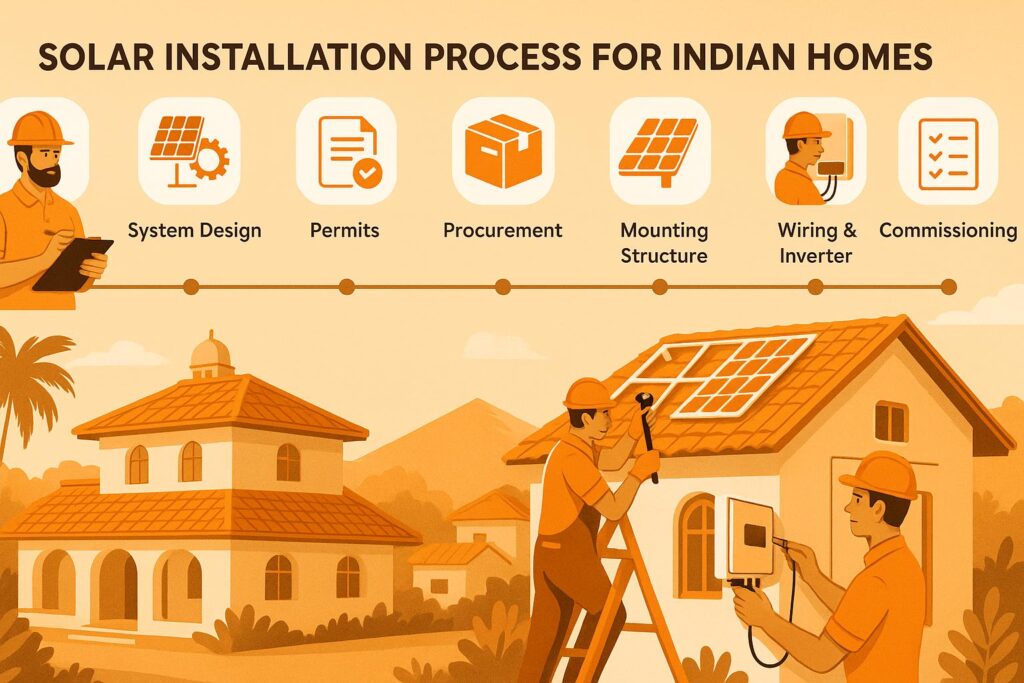
Waaree Solar Panel Installation Process
A solar installation involves several stages, from initial assessment to final commissioning. Here’s how the process typically works.
Step 1: Site Survey
The installer evaluates the available rooftop or ground space, shading conditions, structural strength and electrical infrastructure.
The survey also determines where the inverter will be installed and how the cables will be routed.
Step 2: System Design
Based on the site assessment, the installer determines:
- Required system capacity.
- Number and configuration of solar panels.
- Inverter capacity and specifications.
- Panel orientation and tilt.
- String configuration and electrical compatibility.
- Mounting structure requirements.
The design must ensure that the panel voltage and current remain within the inverter’s specified operating limits.
Step 3: Approvals and Documentation
For grid-connected installations, the required applications and documentation are submitted to the relevant DISCOM.
For eligible residential installations, applicable subsidy registration and documentation under government schemes such as PM Surya Ghar must also be completed.
Step 4: Mounting Structure Installation
Mounting structures are installed based on roof type and structural requirements.
Concrete rooftops may use anchored or appropriately engineered ballasted structures. Metal rooftops generally require compatible clamps and mounting arrangements that preserve roof integrity.
Step 5: Solar Panel Mounting
Solar modules are positioned and secured to the mounting structures using the specified clamps and fasteners.
Explore Waaree solar panels on SuFin Ltd. to discover available products and specifications.
Step 6: Electrical Connections
The installer completes DC and AC wiring, inverter connections, earthing and protection equipment installation.
All electrical connections should comply with applicable safety standards and manufacturer recommendations.
Step 7: Testing and Commissioning
Before the system is commissioned, the installer checks:
- String voltage and current.
- Insulation resistance.
- Earthing continuity.
- Electrical protection systems.
- Inverter configuration.
- System monitoring and expected performance.
Step 8: DISCOM Inspection and Net Metering
For grid-connected systems, the utility completes the applicable inspection and metering formalities. Once the required approvals are obtained, the system can export surplus electricity under the applicable arrangement.
Types of Solar Panel Installations
The right installation type depends on electricity consumption, grid availability, available space and backup requirements.
1. Rooftop Grid-Connected Solar
The most common configuration for residential and commercial buildings. Solar panels generate electricity for immediate consumption, while surplus power can be exported to the grid under applicable net-metering arrangements.
Best for: Homes, offices, shops, factories and warehouses with reliable grid connectivity.
2. Hybrid Solar Installation
A hybrid system combines solar panels, an inverter and battery storage. It can store surplus solar energy and supply selected loads during grid outages.
Best for: Businesses and households that require backup power alongside electricity savings.
3. Off-Grid Solar Installation
An off-grid system operates independently of the utility grid and generally relies on battery storage to provide electricity beyond daylight hours.
Best for: Remote locations, agricultural applications and properties without reliable grid connectivity.
4. Ground-Mounted Solar Installation
Solar panels are installed on structures built directly on available land. These installations offer flexibility in panel orientation, spacing and maintenance access.
Best for: Large commercial projects, industrial facilities and locations with sufficient available land.
5. Solar Water Pumping Systems
Solar-powered pumps use electricity generated by solar panels to operate water pumps. They are commonly used in agriculture and irrigation applications, including eligible government-supported programmes such as PM-KUSUM.
Best for: Agricultural farms, irrigation systems and locations where daytime water pumping is required.
Residential vs Commercial and Industrial Solar Installation
Solar installations are not limited to homes. Commercial and industrial facilities can also benefit from generating electricity on-site.
| Parameter | Residential | Commercial / Industrial |
|---|---|---|
| Typical system size | 1–10 kW* | 20 kW onwards* |
| Primary objective | Reduce household electricity bills | Reduce operational energy expenses |
| Installation location | Residential rooftops | Factories, warehouses, industrial sheds and commercial rooftops |
| Energy consumption | Household appliances | Machinery, lighting, HVAC and production equipment |
| Design considerations | Household load and available roof area | Load profile, sanctioned demand, roof capacity and operating hours |
| ROI considerations | Household tariffs and consumption | Commercial tariffs, self-consumption and project investment |
These are indicative categories rather than fixed capacity limits. Actual system sizing depends on the site, electricity requirements and applicable regulations.
Solar Applications Across Industries
Manufacturing Units: Solar installations can help manufacturing businesses offset daytime electricity consumption from machinery, production equipment and lighting.
Warehouses and Logistics Facilities: Large rooftop areas offer opportunities for installing solar modules to generate electricity for lighting, ventilation and warehouse operations.
Commercial Establishments: Offices, shopping complexes and commercial buildings can use rooftop solar to reduce grid electricity consumption.
Construction and Infrastructure: Solar installations can support electricity requirements across eligible facilities, infrastructure sites and associated operations.
For businesses, the most important consideration is matching solar generation with actual electricity consumption. A well-designed system can improve the utilisation of generated power and the overall project economics.
Solar Panel Installation Cost: What Influences the Pricing?
The cost of installing solar panels depends on system capacity, module technology, inverter specifications, roof conditions and installation requirements.
Two quotations for the same system capacity can differ significantly because of variations in equipment quality, structural design, electrical protection and service inclusions.
Here are the major factors influencing installation costs.
1. System Size
System capacity is one of the biggest cost drivers. Larger installations generally have a lower cost per watt because certain design, mobilisation and labour expenses are distributed across greater capacity.
2. Solar Module Technology
Standard Mono PERC modules are generally positioned differently from higher-efficiency TOPCon and bifacial configurations.
Module selection should consider efficiency, available space, generation potential and project economics rather than wattage alone.
3. Mounting Structure
A straightforward concrete rooftop installation may require less structural work than a sloped roof, elevated terrace or industrial metal shed.
Wind-load requirements, roof condition and mounting height can significantly influence costs.
4. Inverter Type
String inverters are commonly used for conventional installations. Microinverters and optimisers can increase the initial investment but may improve energy harvesting in certain shading conditions.
5. Battery Storage
Battery storage can substantially increase project costs. Hybrid installations require additional equipment and storage capacity, so their economics should be evaluated against the value of backup power.
6. Roof Condition and Accessibility
Multi-storey buildings, difficult access, roof repairs and complex cable routing can increase installation and labour expenses.
7. Subsidy Eligibility
Eligible residential installations may qualify for central financial assistance under PM Surya Ghar, subject to current scheme guidelines, approved capacity, vendor requirements and applicable domestic sourcing conditions.
Commercial and industrial installations should not assume eligibility for the same residential subsidy.
8. Location
Transportation, labour costs, local installation conditions and state-specific approval requirements can influence the final quotation.
Solar Installation Cost Per Watt
The solar industry commonly compares project costs on a per-watt basis to evaluate installations of different capacities.
For an indicative residential grid-connected rooftop installation in India, a planning range of ₹45–₹65 per watt* may be used as a preliminary estimate. Actual quotations can vary depending on equipment, installation scope, location and market conditions.
For example:
| System capacity | Indicative cost range |
|---|---|
| 3 kW | ₹1.35 lakh–₹1.95 lakh* |
| 5 kW | ₹2.25 lakh–₹3.25 lakh* |
| 10 kW | ₹4.50 lakh–₹6.50 lakh* |
These figures are illustrative pre-subsidy estimates, not standard market prices or guaranteed quotations. Confirm whether the quoted amount includes GST, structural work, inverter, electrical protection, installation, approvals and net-metering coordination.
Commercial and industrial installations may have different per-watt economics depending on project scale and technical requirements.
Solar Panel Installation ROI: Investment, Savings and Payback
The initial installation cost is only one part of evaluating a solar project. Buyers should calculate the system’s expected electricity generation, determine how much electricity they will consume on-site, and estimate the cost savings they can achieve.
Consider the following illustrative example.
Example: 10 kW Commercial Rooftop Solar Installation
| Parameter | Assumption |
|---|---|
| Installed capacity | 10 kW |
| Estimated installation cost | ₹5,50,000* |
| Monthly electricity generation | 1,200 units* |
| Electricity tariff | ₹8 per unit* |
| Potential monthly savings | ₹9,600* |
| Potential annual savings | ₹1,15,200* |
| Simple payback period | Approximately 4.8 years* |
How is this calculated?
Monthly savings = 1,200 units × ₹8 = ₹9,600.
Annual savings = ₹9,600 × 12 = ₹1,15,200.
Simple payback period = ₹5,50,000 ÷ ₹1,15,200 = approximately 4.8 years.
All figures are illustrative estimates based on assumed project parameters. Actual generation, savings and payback depend on location, system configuration, self-consumption, export tariffs, electricity charges, maintenance, degradation and financing costs.
For a more accurate ROI assessment, businesses should evaluate their electricity bills, daytime consumption patterns, sanctioned load and available rooftop area before finalising the system capacity.
How to Choose the Right Solar Installer
Choosing the right installer is as important as selecting the solar panels. Installation quality directly influences system performance, safety and long-term reliability.
Before finalising an installer, ask these questions:
- What is the expected annual energy generation? Ask for a generation estimate based on location, shading, panel orientation and system configuration.
- What mounting structure will you use for the solar system? Ensure it uses durable materials, has adequate corrosion protection, and is structurally suitable for the installation.
- What safety equipment is included? Confirm earthing, surge protection, isolators and appropriate circuit protection.
- What warranties are provided? Understand the separate warranties for modules, inverter, product performance and installation workmanship.
- Who handles approvals and net metering? Clarify responsibilities for DISCOM applications and documentation.
- Is system monitoring included? Ensure that you can track generation and identify performance issues.
- What happens if the system underperforms? Understand the installation and after-sales service commitments.
A lower quotation is not necessarily a better investment. Evaluate the equipment, installation scope, warranties and expected generation before making a decision.
Explore Waaree Solar Products on SuFin Ltd.
Selecting suitable solar modules is an important step towards building an efficient solar installation.
SuFin Ltd. provides a platform to discover solar products from manufacturers and sellers, compare available specifications and explore products for different procurement requirements.
Whether you’re sourcing solar panels for a residential project or evaluating bulk requirements for a commercial or industrial installation, explore the available range.
Explore Solar Panels: https://lntsufin.com/catalog/solar-equipments-panels/solar-panels/solar-pv-panel/
Explore Waaree Products: https://lntsufin.com/sellers/waaree-energies-limited
Looking for bulk procurement? Explore product listings on SuFin Ltd. and enquire about your project requirements.
Need financing for your procurement? Eligible buyers can explore trade credit options offered through SuFin Ltd.’s lending partners, subject to lender assessment and approval.
Frequently Asked Questions (FAQs)
Q1. What is the process of Waaree solar panel installation?
The process includes site assessment, system design, approvals, mounting structure installation, panel mounting, electrical connections, testing and commissioning. For grid-connected systems, applicable DISCOM approvals and net-metering arrangements must also be completed.
Q2. How much does Waaree solar panel installation cost?
An indicative residential grid-connected rooftop installation may cost around ₹45–₹65 per watt*. A 3 kW system could therefore cost approximately ₹1.35 lakh–₹1.95 lakh*. Actual costs depend on module technology, inverter specifications, roof conditions, installation scope and location. Battery storage can increase the investment.
Q3. Which Waaree solar panel is suitable for residential and commercial installations?
The right panel depends on system capacity, available space, efficiency requirements and project specifications. Waaree offers Mono PERC bifacial modules and complete on-grid solar solutions. Buyers can compare individual modules and bundled systems based on their requirements.
Q4. Can factories and warehouses install Waaree rooftop solar panels?
Yes. Factories, warehouses and commercial establishments can install rooftop solar systems to offset a portion of their electricity consumption. System design should account for rooftop capacity, structural strength, operating hours and electricity demand.
Q5. Can I get a subsidy for Waaree solar panel installation?
Eligible residential consumers may receive financial assistance under the PM Surya Ghar scheme, subject to current government guidelines, approved vendors and applicable domestic sourcing requirements. Commercial and industrial installations generally do not qualify for the same residential subsidy.
Q6. How long does solar panel installation take?
A typical residential installation takes approximately one to three days* of on-site work. Commercial and industrial projects may take longer depending on system capacity and site complexity. Additional time may be required for DISCOM approvals and net-metering formalities.
*All cost and timeline figures are illustrative estimates. Actual figures depend on project specifications, location and site conditions.
Last Updated: 12 November 2026